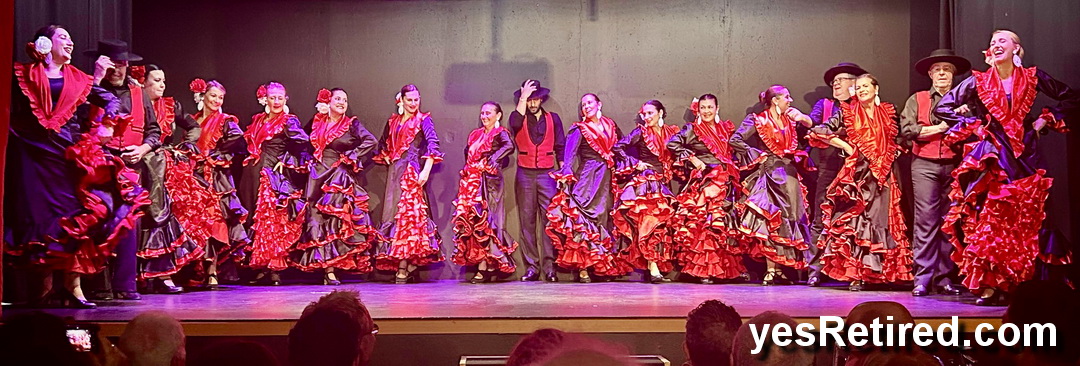
We’ve grown to truly appreciate the beauty and intensity of Flamenco dancing during our time in Spain. It’s impossible not to be swept up in the swirl of vibrant dresses, the dramatic lift of a skirt, and the expressive movements of the dancers. Their footwork pounds out a fierce rhythm, punctuated by the sharp click of castanets fluttering in their hands. The music that drives it all usually comes from a male singer accompanied by a guitarist, delivering vocals with a passion that feels almost operatic—though in a more restrained, monotone style. Audience partipation is sometimes encouraged with a rhythmic clapping pattern.
The image’s here are from an incredible free performance at the Casa de la Cultura “Manuel Delgado Perea” in Costa del Sol, Spain featuring 17 performers, two costume changes, and four musicians and vocalists.
As an English speaker with only modest Spanish, I often feel like I’m missing part of the story—unable to fully grasp the lyrics or narrative behind the dance. But the emotion still comes through. The music, the movement, the energy… it’s all unmistakably powerful. It’s the kind of performance you feel, even when you can’t understand every word.
Understanding Flamenco
This performance made me want to better understand this folk art form better, from an English speaking person’s perspective. I came to understand there is a dimension of improvision similar to jazz music.
Translated Lyrics from a song
That I loved you madly (repeated verse)
In my life I will never deny
that I loved you madly (repeated verse)
look at the love it was
that I feel the passions
that your love left me with.
Flamenco is far more than singing, dancing, and guitar. It is a living expression of tradition and culture, something that resonates deeply in the lyrics themselves. This universal art form was born from cultural blending and, for many, it represents an entire way of life. Its close connection to everyday experiences—their emotions, struggles, and joys—runs through every performance, where themes like love, loss, happiness, and sorrow are ever‑present.
As time has passed, flamenco has evolved in every dimension. New instruments such as the cajón have joined its sound; accessories like the fan and shawl have become part of its visual language; fresh sonic influences have been woven in; and it has even fused with genres like jazz. This evolution is equally evident in the lyrics sung by its performers. Alongside timeless themes like love and death, modern flamenco now embraces subjects such as loneliness, social issues, and political protest, reflecting the world in which it continues to grow.
Flamenco singing lyrics have an Andalusian accent
(adapted from The lyrics in flamenco singing | El Palacio Andaluz)
The lyrics in flamenco singing are a means of expression, messages that the singer makes his own putting his feelings during his performance. Hence, in flamenco singing, nonverbal language is so important for these artists.
The theme and mood with which it is sung is marked by the flamenco club that is interpreted. Each one is designed to touch each other at a specific time. For example, Sevillanas, due to their rhythm, are typical of a festive atmosphere. It is perhaps the most universal and well-known flamenco style and it is usual to dance it in Andalusian fairs. However, soleá or fandango are more solemn songs that address deeper feelings.
Another quality that the flamenco cante lyrics have is the way they are sung, with an Andalusian accent. The verses adapt to this speech, also giving it an agitated touch, which allows words to be lengthened or shortened in order to adapt them to the metric. For this reason, there are those who find it difficult to understand the lyrics of a flamenco singer, hence the interpretation is so important.
Flamenco is consolidated as an art that runs through everyone’s moods and concerns, something that has influenced their popular character. In fact, it is common for flamenco singers themselves to modify the lyrics at will, as, for example, occurs in this soleá. The original letter is as follows:
No preguntes por saber
que el tiempo te lo dirá
que no hay cosa más bonita
que saber sin preguntar.
However, the cantaor changes it like this:
No preguntes por saber
que el tiempo te lo dirá
Ay, no preguntes niña
que el tiempo te lo dirá.
que no hay cosa más bonita
que saber sin preguntar.
There are different types of letters and styles that use them:
The tercerillas: 3-verse letters widely used in bulerías, alegrías and tientos. Its rhyme is from ABA, whose words in each verse vary according to the flamenco style in which it is used, in this case we see that of the bulería or tercerilla soleá, which consists of octosyllable verses, that is, it has eight words.
Yo no le temo al castigo
y en medio la Calle Nueva
me paro y hablo contigo.
The coplas or quartet octosyllable: four verses of 8 syllables, common of the soleares In this case, the last word is usually lengthened to give way to the following stanza:
A la mare de mi alma
lo que la camelo yo
porque la tengo presente
metida en el corazón.
The fandangos or the quintillas: although the right thing would be to talk about sexteta, since it has six verses, the truth is that in fandangos one of the phrases is usually repeated, which makes it really have only five.
Que te quise con locura (repeated verse)
Yo en mi vida negaré
que te quise con locura (repeated verse)
mira que cariño fue
que siento las calenturas
que me dejó tu querer.
These are just some examples of lyrics in flamenco singing and their use. However, when you go to a live flamenco show, on many occasions the singer can improvise the lyrics, as is the case with dancing. It is something that brings freshness and life to this art. If you are in Seville, do not hesitate to go to a flamenco tablao and see in first person what the interpretation of the lyrics of each flamenco style is like.
Conclusion
If you ever have a chance to see a Spanish Flamenco dancer, be sure to take the moment to enjoy it. When we visited Seville, Spain, they were even there as buskers in the streets. See our related articles below:
Please SUBSCRIBE to our NOTIFICATIONS
If you would like to be notified of more articles like this, please LIKE our Facebook page, which will then include us in your Facebook feed. Use this LINK to take you to our page, then click the LIKE button shown below. Or Like our twitter feed.